FORGING YOUR UNIVERSE...
FORGING YOUR UNIVERSE...
⟡ REFERENCE SHOWREEL
Nine live builds on one turning reel. Scroll to spin it, then press play on any card to open the site.
⧡ CASE NOTES
Nine builds, nine different problems. Every card above opens the live site; the notes below are what was actually built and why.
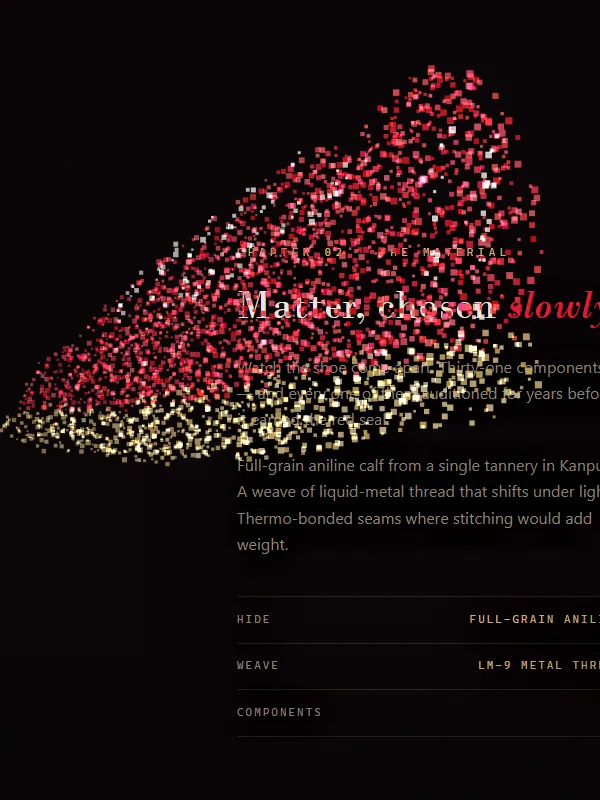
A hundred numbered pairs, hand-finished in Kanpur, cut from carbon and calf. The problem with a limited edition is that a catalogue page flattens it: a grid of thumbnails says nothing about why one silhouette took a year to resolve.
So the site is built as a scroll rather than a shop. Five chapters — Origin, Silhouette, Matter, Propulsion, Signature — take the visitor through the making of the shoe before anything is offered for sale, with particle-driven reveals carrying each transition and colourways switching live in the configurator. Accounts exist for one reason: with an edition of one hundred, registering is your place in the queue.
Five generations and forty-five years of a single nameplate, ending in a call to action that has to survive all that history: reserve a test drive. A specification table would have wasted the story, and a story with no booking would have wasted the traffic.
The build makes the timeline the navigation. Holding and scrolling drives through 1978 and the first stretched Celica, 1986 and the turbo era, 1993 and the twin-turbo 2JZ, then the seventeen-year silence from 2002 to 2019 before the GR Supra returns. Reservation sits at the end of that journey, where a visitor has been given a reason to want it, alongside a gallery and an FAQ for the people who arrive already convinced.
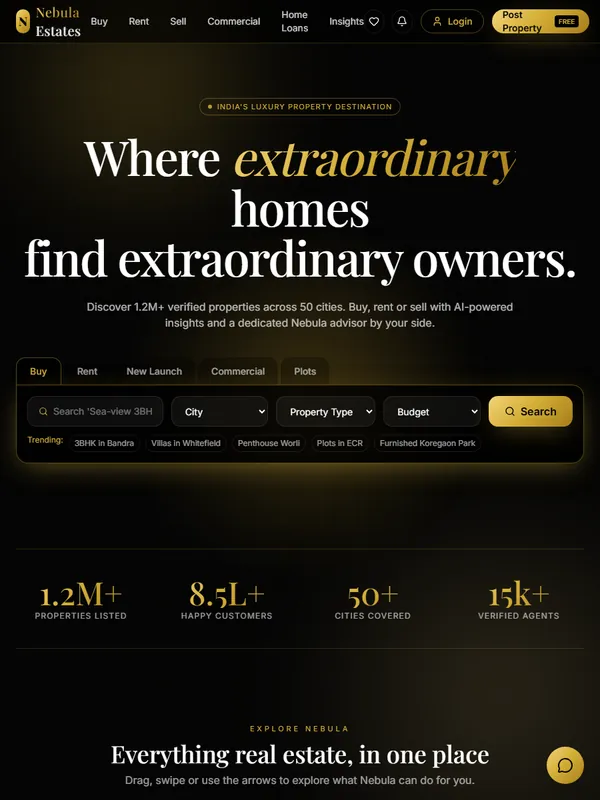
A catalogue of this size — 1.2 million listings across fifty cities, with 15,000 verified agents behind them — fails in the opposite direction to a limited edition. Nothing is scarce; the difficulty is getting one person to the handful of homes that matter to them without making them scroll through the rest.
Search leads, therefore, and it leads on the axes buyers actually think in: city, property type, and a budget band from under ₹1 crore to ₹10 crore and above, split across buy, rent, new launch, commercial and plots. Verification is the product's real promise, so it is stated on the listing rather than buried in a trust page, and an advisor route runs alongside the self-serve one for people who would rather ask than filter.
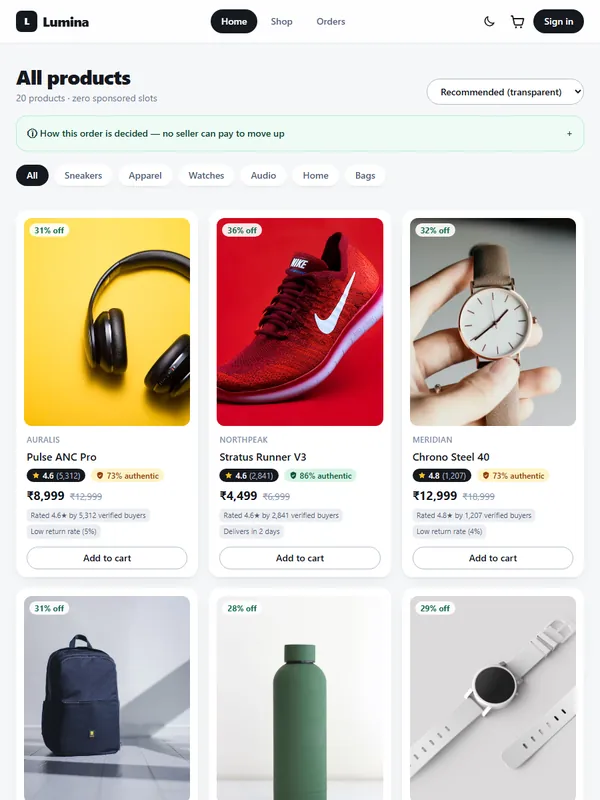
A storefront built to argue with how storefronts usually behave. Marketplaces make money from paid placement and volume reviews, and shoppers have learned to discount both, so the interesting design question is what a store looks like when it gives those up on purpose.
Three commitments are made in the interface rather than in the small print: no pay-to-rank listings, reviews only from verified purchases, and a delivery countdown backed by an SLA rather than an estimate. Products rotate in 3D so the thing itself is inspectable before purchase — the honest substitute for the photography tricks the model is rejecting.
Visit the live demo ↗ — a demo storefront; no real payments are processed.
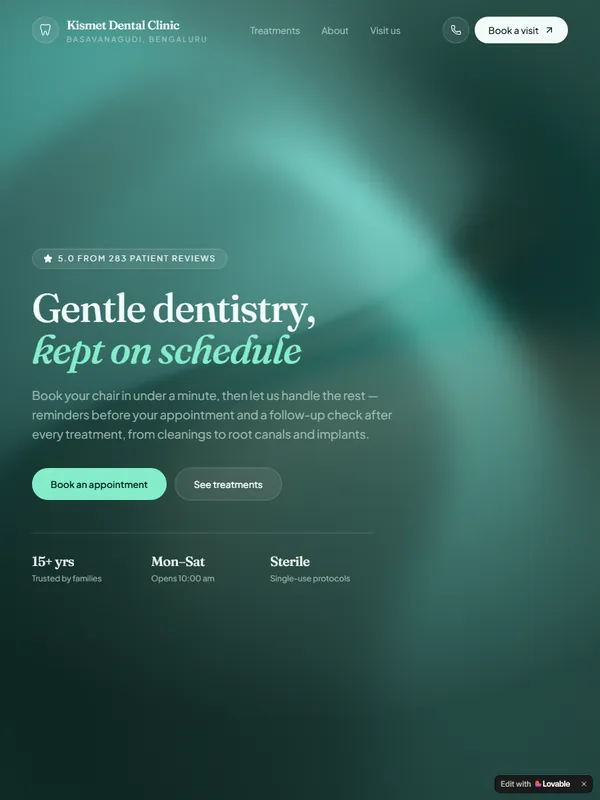
A clinic on Bull Temple Road with families who have kept the same dentist for fifteen years and a 5.0 rating across 283 reviews. Word of mouth like that does not need persuading copy; what it needs is for booking to be as easy as the recommendation that sent someone there.
So the site is organised around one action. Picking a slot and saying what is bothering you is the whole of the first step, and what happens after it is promised on the home page rather than discovered later: sterile instruments and no procedure without your go-ahead, then a check-in call after treatment and a reminder when the next visit is due. Treatments are written for a nervous patient rather than a dentist — a single-sitting root canal, implants planned digitally to your bite.
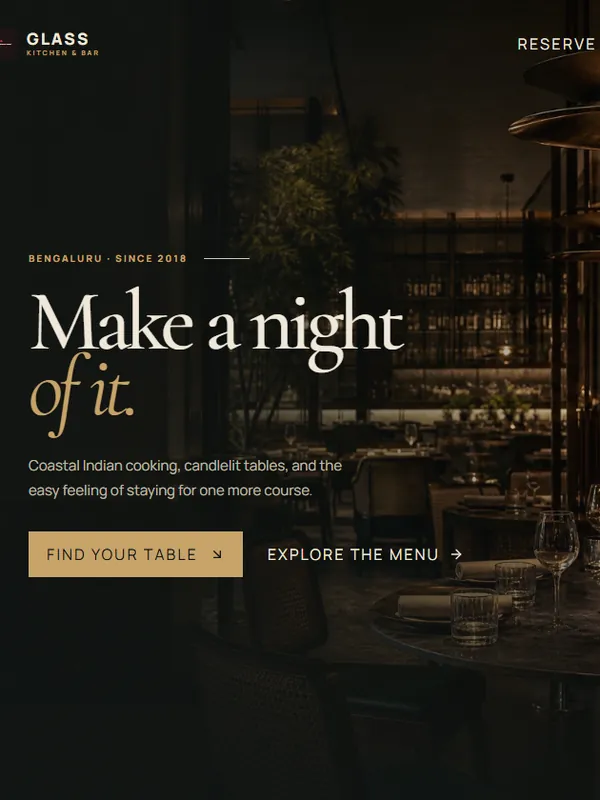
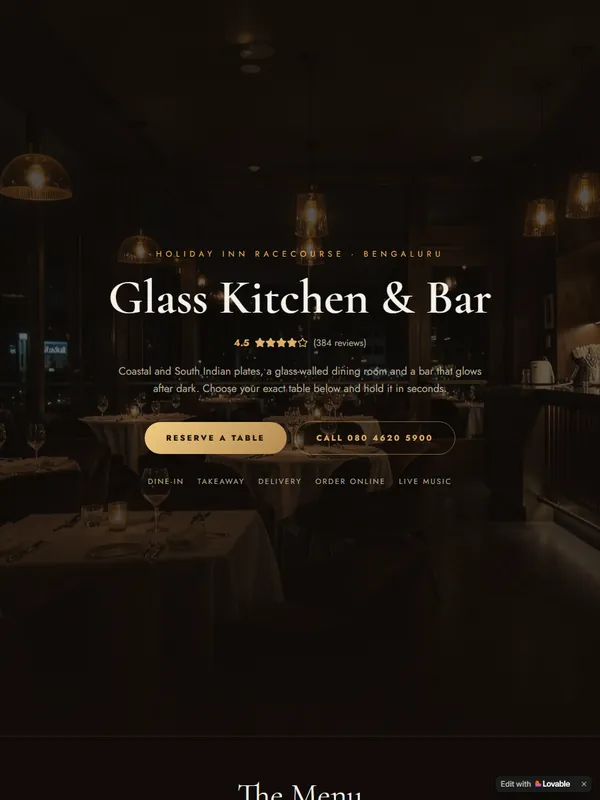
A dining room on the second floor of Holiday Inn Bengaluru Racecourse, selling an evening rather than a meal: coastal Indian cooking, candlelit tables, and a reason to stay for one more course. A menu and a phone number would have described the food and missed the room entirely.
The build introduces the room before the menu, and keeps the menu to five signature plates — lobster mappas, appam and stew, tandoori chops — each with a link to reserve around it rather than a price list to scan. Booking is a live view of the room: tap an available table to see its character, choose a sitting, and hold it with a ₹500 token advance adjusted against the bill.
Visit the live site ↗ — the checkout is a demo; payment integration is ready to connect, and no real payments are taken.
The same restaurant approached from the other end: not the evening, but the seat. Most booking tools take a time and a party size and leave the table to chance, which throws away the thing a glass-walled dining room is actually selling.
So the floor plan is the interface. Visitors spin the room in 3D, tap one of eleven glowing tables seating two to six, and hold it with a refundable token advance that comes straight off the final bill. The menu above it is cut down to the most-ordered plates, as picked by 384 diners, so that the page never stops being a booking page.
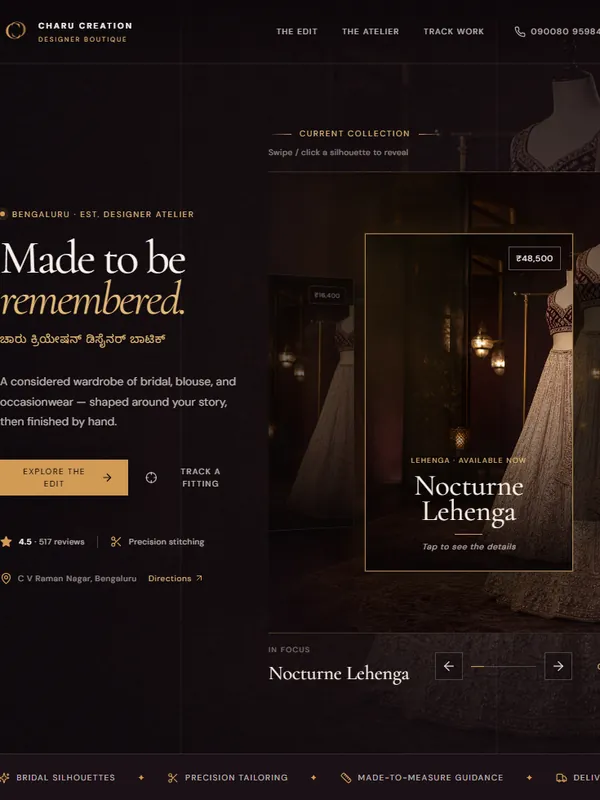
Bridal and occasionwear are chosen once and then made over weeks — pattern cutting, fittings, handwork, the final press. The anxious part of commissioning a lehenga is not choosing it; it is the waiting, with no idea where the garment has got to.
The site answers both halves. The collection is a rail of silhouettes — lehenga, blouse, saree, occasionwear — priced openly, from a ₹12,800 blouse to a ₹48,500 bridal lehenga. And the waiting gets a feature of its own: the track ID printed on the studio card opens the garment's timeline, with the latest fitting note, the next milestone and the pickup date. The boutique's name is set in Kannada beneath the English.
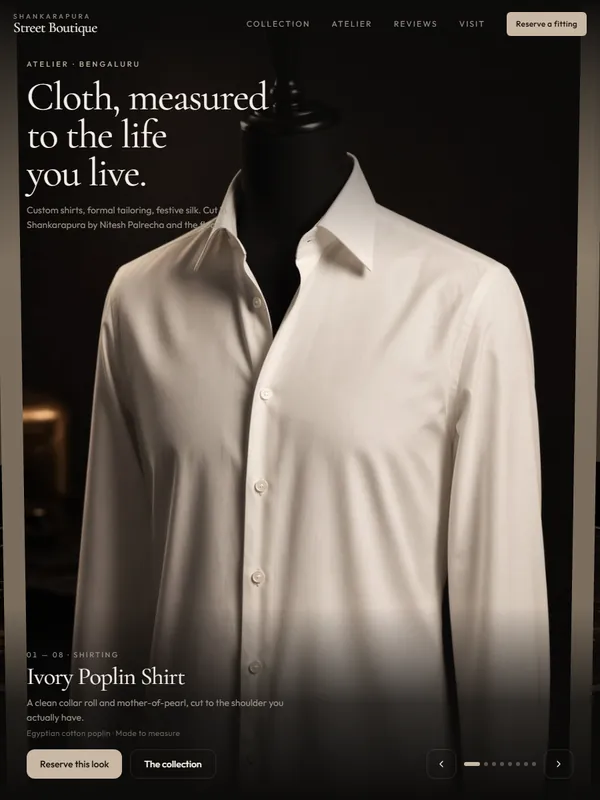
A made-to-measure floor off 1st Cross in Shankarapura, kept by Nitesh Palrecha, where guests come for the fabric and stay for a master who marks and cuts until the shoulder sits. Tailoring is awkward to sell from a screen: the product does not exist until you have been measured for it.
So the site shows the rail rather than a catalogue. Eight looks — ivory poplin, a charcoal double-breasted in superfine merino, handloom raw silk, Belgian linen — turn like a floor you are walking past, filtered by shirting, tailoring, festive, linen and evening, and every one ends in the same invitation: reserve a fitting. Hours, WhatsApp and directions sit at the foot, for the part of the job that still happens in person.